What Agrii’s Digital Technology Farm trial shows about agronomic decision making
RHIZA – Making digital farming work for you
JUNE, 2026
Blog
Can digital tools improve agronomic decisions when they are used together across a whole crop programme?
That is the question behind Agrii’s Digital Technology Farm trials at Revesby Estate in Lincolnshire.
The trials compare a technology-led agronomy programme with the farm’s standard approach, using tools including soil mapping, drone crop analysis, satellite imagery, disease risk modelling and variable rate application.
In the latest wheat trial, the technology-led side of the field yielded 0.82 t/ha more than the farm standard and delivered an additional gross margin of £137.63/ha after variable costs and technology expenses were taken into account.
Testing digital agronomy against the farm standard
The aim of the Digital Technology Farm is not to replace agronomy with technology.
Instead, it tests how different systems, sensors and software can contribute to agronomic decisions when used together in a commercial farming situation.
Last season, a field of LG Redwald feed wheat was split between the farm’s standard programme and a technology-led approach.
RHIZA zonal soil sampling was used first to understand soil composition, pH and organic matter across the field and create a relatively even split between the two treatments.
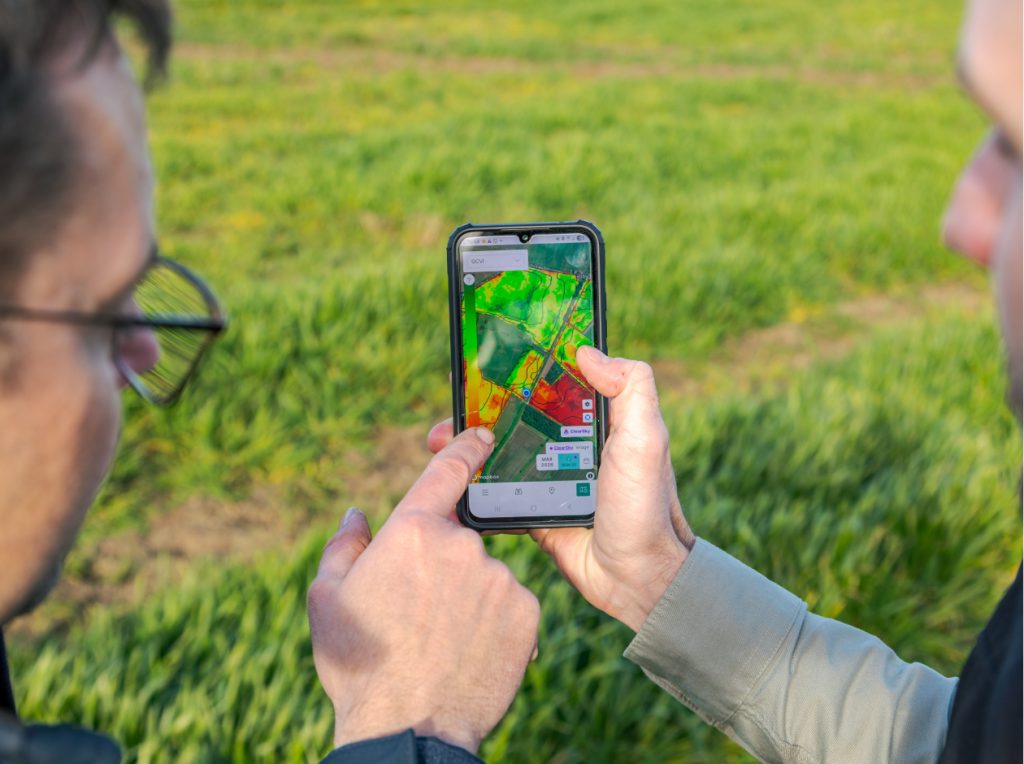
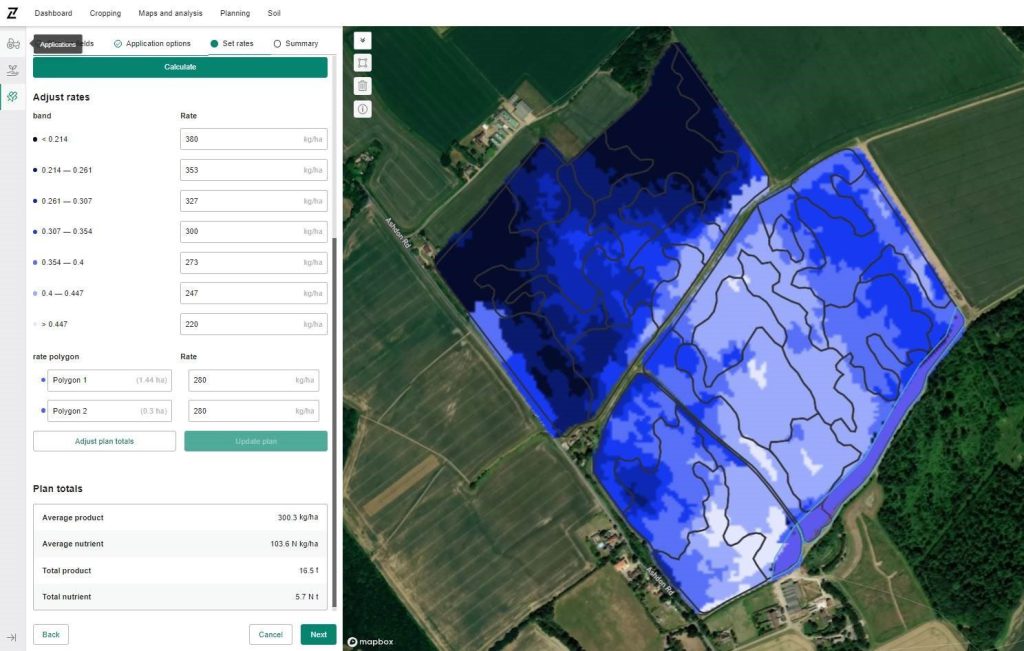
The technology-led area then used a combination of Skippy Scout drone imagery and NDVI satellite data from Contour to build variable rate nitrogen plans.
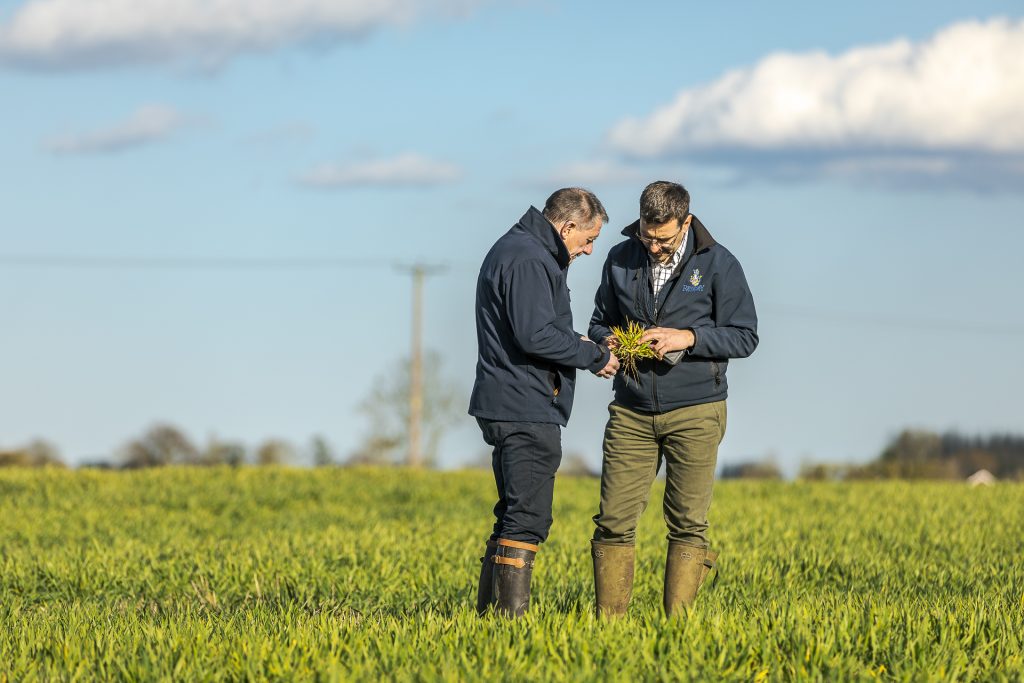
“We combined the approach of using Skippy Scout drone analysis for a crop-specific green area index, measuring points across all the different soil zones,” explains Jonathan Trotter, Technology Trials Manager at Agrii.
“NDVI maps from the Contour platform were then used to correlate the GAI to produce a nitrogen application map for each timing.
“This way, we can combine field-scale remote sensing with much more specific crop scanning from the drone.”
Using variable rate nitrogen to match field potential
The yield target for the LG Redwald crop was set according to soil type and previous trial experience.
The team targeted 10 t/ha at 9% grain protein on the medium soil and 8.5 t/ha at the same protein level on the lighter land.
This allowed nitrogen applications to be adjusted according to the potential of different areas of the field rather than applying a uniform strategy.
“On average, the technology-led side of the field spent 15% less on nitrogen than the farm strategy,” says Jonathan.
“On the sandy part of the field, this dropped to 40%. Overall, this was a £30/ha saving on nitrogen.”
The technology-led treatment used variable rate nitrogen for both application splits, while the farm standard used variable rate spreading for the second application only.
Jonathan says this difference was one of the main contributors to the results.
“We achieved a 60% nitrogen use efficiency, with 15% less nitrogen used, which is really positive.”
Using disease data to guide fungicide decisions
The trial also used several sources of information to support fungicide decisions.
Variety susceptibility provided the starting point, while Contour’s disease risk tool was used to indicate changing disease pressure through the season.
BioScout, a smart spore trap installed part-way through the season, added another layer of information by detecting airborne fungal spores.
The device captures spores in the field and uses microscopy and AI to identify different disease types.
“Combining the information from BioScout on what diseases were detected with the disease risk indication in Contour, added to us walking the crop to see what disease we could find, gave us the basis for building the fungicide programme,” says Lucy Cottingham, Digital Agronomy Development Manager at Agrii.
The approach allowed the team to react to the season rather than simply follow a fixed programme.
Lucy says one of the main learnings from the dry year was that retaining green leaf area late into the season did not necessarily deliver the expected benefit where drought caused the crop to senesce earlier.
“One of the learnings from the dry season last year was that we didn’t necessarily get the benefit of pushing late green leaf area retention because the crop droughted out by the time you would expect to see the benefit.”
What the trial delivered
The technology-led half of the field yielded 0.82 t/ha more than the farm standard.
After differences in variable costs and technology expenses were included, this equated to an additional gross margin of £137.63/ha.
The result should not be attributed to one technology in isolation.
The programme combined variable rate nitrogen, crop scanning, satellite imagery, disease risk information and other crop health decisions, with the interaction between these elements forming part of the trial.
For Revesby Estate Farms Manager Peter Cartwright, variable rate nitrogen has been one of the clearest practical lessons.
“We started looking more at our nutrient use efficiency and the savings we can make,” he says.
“It’s about paying more attention to what the maps are telling us in Contour, and the variable rate application after that.”
Technology still needs interpretation
Peter says the trial has also reinforced the importance of understanding what the technology is showing before changing management across the whole farm.
“I expect all the other technology will come, like the spore traps. But understanding what it’s telling you and how to use it is still in development.
“At the moment, I don’t want to risk my whole farm area because a piece of technology is telling us not to do anything because there’s no disease.”
This is central to the Digital Technology Farm approach.
The value is not simply in collecting more data. It is in understanding how that information should influence an agronomic decision and where it is reliable enough to use at scale.
Applying the trial findings across the farm
Variable rate nitrogen
Peter says variable rate nitrogen is already moving from trial work into wider use across the estate.
“The trials have shown us what savings we can make and benefits we can get from using variable rate nitrogen, especially for the second application in the spring.”
In the current trial field, satellite imagery has highlighted areas where establishment has been affected by oat residue and slug pressure.
Variable rate nitrogen gives the team the option to adjust applications in response to that variation rather than treating the whole field in the same way.
Autonomous drone monitoring
Peter already uses Skippy Scout for crop monitoring but says the practical limitation is the time required to fly large numbers of fields manually.
“For OSR, Skippy Scout is fantastic for getting GAIs. But I don’t have the time to spend hours scanning every field on the farm, especially when I already have satellite imagery available.
“The drone technology becomes very interesting when it can start flying autonomously. I could have one or two drones constantly scanning the farm, so when I sit down with my agronomist, we can look at the data and identify what is happening where to target our crop inspections.”
Using Contour day to day
Contour acts as the main platform bringing the different information sources together within the Digital Technology Farm.
Peter says that has also increased its use in day-to-day farm management.
“Contour is my go-to now. I can have issues with other technologies, but Contour is simple. It is just a few clicks, and I am up and running, pulling up a map or a prescription.”
Technology being tested in 2026
OptiGene disease diagnostics
The 2026 trial programme will include OptiGene, a rapid diagnostic system based on DNA amplification technology.
The tool can test leaf material for the presence of disease, with the aim of providing additional information on latent infection as fungicide decisions are being made.
Lucy sees potential for this type of diagnostic tool to support agronomists when assessing crops in spring.
PerPlant tractor-mounted crop scanning
A PerPlant camera system has also been fitted to the Revesby sprayer tractor.
The tractor-mounted system uses AI-enabled cameras to record crop information as machinery moves through the field.
The data will be assessed alongside satellite and drone imagery to understand where tractor-mounted sensing can add another useful layer of information.
Soil Acoustics
The trials are also assessing Soil Acoustics technology, which records sounds produced by invertebrates within the topsoil.
The system uses the volume and diversity of biological activity detected in the soil as an indicator that can be considered alongside other soil measurements.
This will allow the team to explore whether acoustic monitoring can contribute useful information to wider soil assessment.
Testing where digital farming adds value
The Revesby Digital Technology Farm is designed to test technologies in combination, rather than assess individual tools in isolation.
The latest results show that a technology-led approach can influence input use, crop management and margin, but also reinforce the need for agronomic interpretation.
The aim is not to automate every decision. It is to identify which technologies provide useful information, how they work together and where they can improve decisions on farm.
Speak to the RHIZA team or your Agrii agronomist about using Contour, variable rate applications and digital crop monitoring within your farm business.
Lorem ipsum dolor sit amet, consectetur adipiscing elit. Ut elit tellus, luctus nec ullamcorper mattis, pulvinar dapibus leo.